Breaking Chains: The Financial Trauma We Didn’t Sign Up For
Words: Melissa Byrne
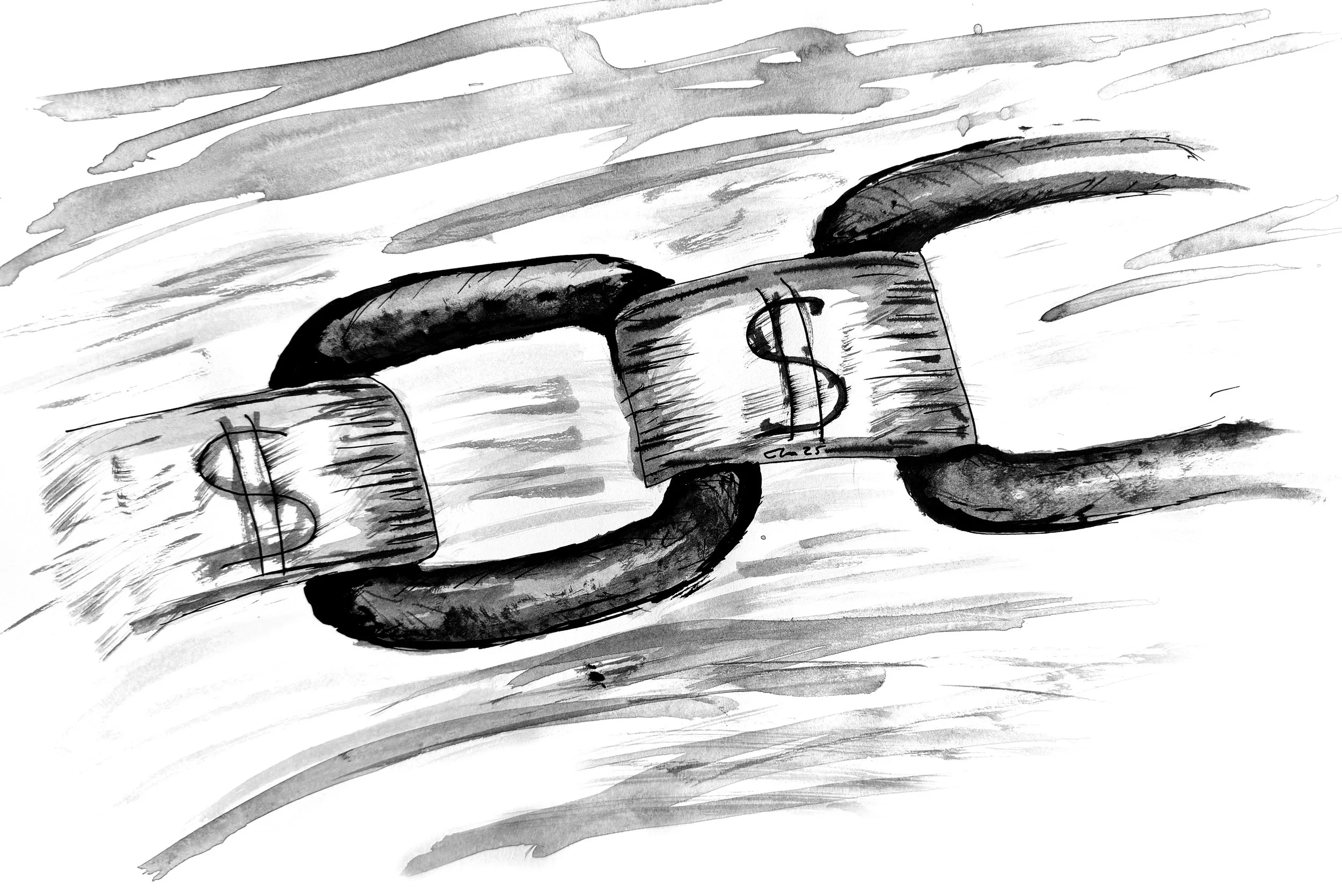
Illustration: Charles Longey
Have you ever felt your relationship with money was rigged from the start? That someone else wrote the rules, hid the map and told you to smile while you played along? The reality is, this rigged money game isn’t your fault. The barriers between women and wealth were built long before now. We inherited them quietly and they live beneath our skin like muscle memory.
Australia’s history makes it clear. Early on, colonial women weren’t just excluded from wealth – they were written out of it. Under British coverture laws, carried into colonial Australia, a married woman ceased to exist as a legal person. Her property, her income and even her decisions belonged to her husband. It was a legal fiction that offered control, not care.
Then the loosening of patriarchal financial control begins.
1870s–1890s: The Married Women’s Property Acts swept across the colonies – New South Wales in 1879, and the remaining states passed similar legislation between 1890-97. For the first time, a woman could own and control her assets. A quiet revolution. A spark of sovereignty whispering, we can govern ourselves.
1902: Australian women became the first in the world to win both the vote and the right to stand for federal parliament. Yet banks still refused loans, and married women were forced to resign from public service with the "marriage bar”. Marriage erased your income as neatly as it added a ring.
1966: The “marriage bar” is finally lifted. For nearly fifty years, women could not hold permanent government roles once they married. That policy ended the same decade humans walked on the moon. A woman could orbit Earth before she could keep her job after her wedding.
1970s: Banks begin letting women apply for credit in their own names, though many are still asked for a male guarantor. The message lingered: finance was a man’s responsibility, not a woman’s right.
1972: The Equal Pay Case recognised equal pay for equal work. On paper, yes. In practice, the gap persisted – widened by maternity breaks, unpaid labour and industries undervalued precisely because women filled them.
1984: The Sex Discrimination Act made it illegal to discriminate by sex or marital status in work, education or finance. For the first time, the law acknowledged a woman’s right to a loan, a job, an education — as her own person.
1992: Compulsory superannuation arrived, giving women a pathway to retirement savings. But generations before had already missed the compounding growth, the safety net, the inheritance of wealth. Financial independence, in practice, is barely thirty years old.
Even as the laws caught up, the conditioning stayed. We could work, but not earn too much. Manage a home, but not a balance sheet. Be trusted with children, but not capital. Money was a man’s conversation and good women stayed quiet. Yet we kept the country running. The unpaid labour of women – caregiving, child-rearing, emotional management – has fuelled the Australian economy for centuries. Work that builds nations but never sees a payslip. Love offered freely while the system grew rich on our silence.
Behind closed doors another truth persisted: economic abuse, the quiet weapon of control. Partners withholding money, limiting autonomy, hiding behind systems still biased in their favour. It’s the modern echo of coverture, just digitised.
The result? Wealth gaps that distort our economy. Australian women retire with 25 to 30 per cent less super than men despite living longer. We still receive less than 20 per cent of venture capital funding. We still perform invisible labour that props up the very systems that forgot to pay us.
But history didn’t expect our appetite. Our refusal to stay small. The way we turn scarcity into strategy and chaos into currency. The way we rise. Across studios and service industries, offices and outback towns, women are rewriting the rules. Speaking the language of money fluently, playfully, powerfully. Building wealth with empathy and intuition. Defining success not through compliance, but through sovereignty – sovereignty with substance, depth, and the kind of unapologetic self-trust no system can contain.
Because money isn’t the enemy. It’s energy. It expands for those who respect it and contracts for those who fear it. It’s neutral until you touch it. Then it becomes art.
Healing from financial trauma isn’t about spreadsheets. It’s about reclamation – unlearning obedience and remembering that money responds to ownership, not approval. Standing tall in your own value and saying, without hesitation, I’m allowed to thrive. Financial freedom isn’t rebellion against men – it’s rebellion against imbalance.
And this is where I stand. I want equality for everyone – women, men, and anyone ready to build a world where balance replaces hierarchy. The patriarchy may have written the majority of the past, but the future? That’s everyone's to author. Because power looks different now. It looks like women talking openly about money. It looks like wealth built with empathy. It looks like equality – not just in theory, but in practice. And maybe, just maybe, that’s the most seductive revolution of all.
From A New Era for Numbers – a manifesto for financial sovereignty, soulful business and the reclamation of wealth as a force for freedom. Available now at thenumbersmiths.com.au